
On October 13th, Erkki Mäeorg defended his doctoral thesis at the Estonian University of Life Sciences, entitled “Stress tolerance and cultivation technologies of oilseed hemp – their effect on plant productivity and seed quality”.
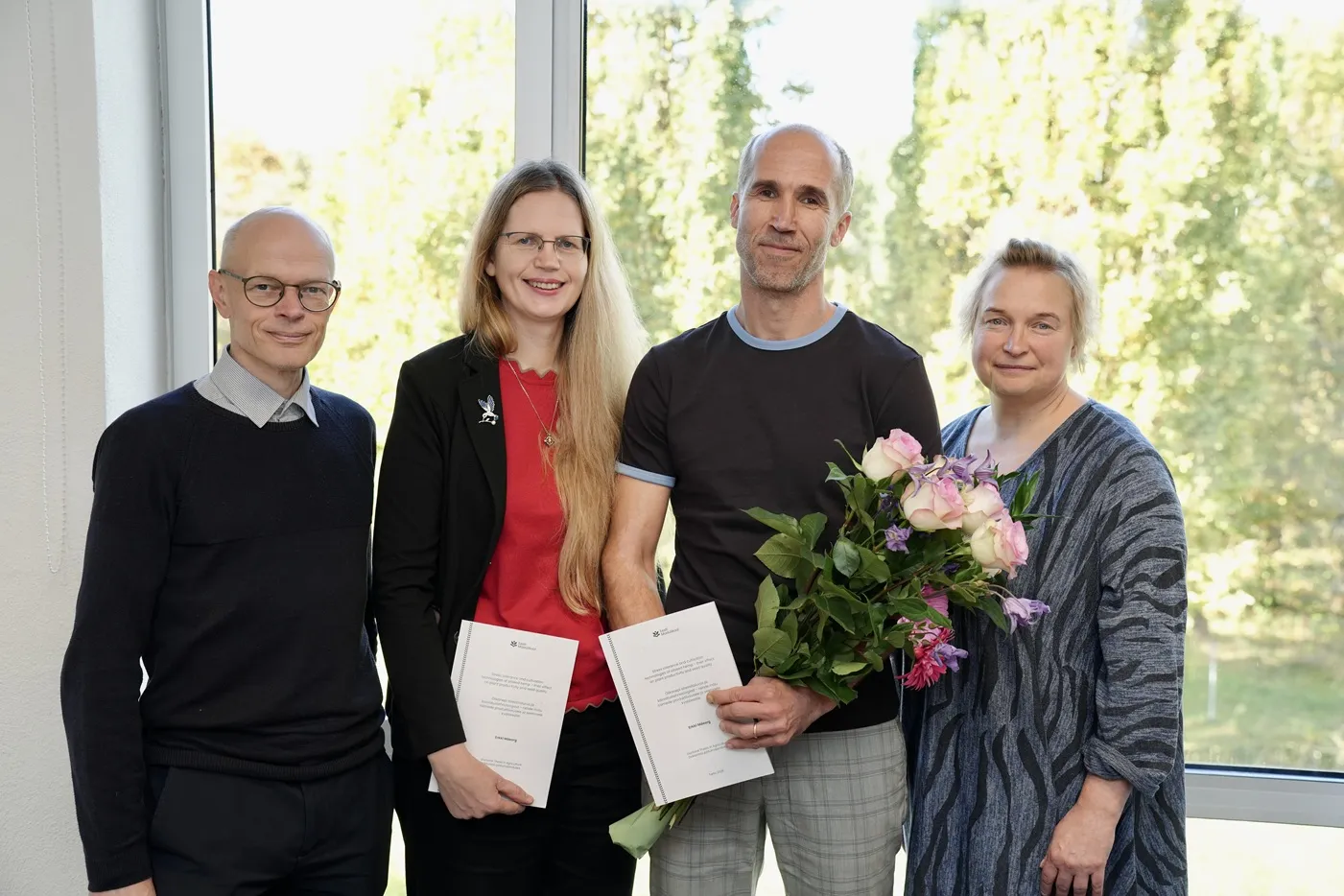
The thesis was supervised by Professor Eve Runno-Paurson, Professor Ülo Niinemets and Dr Astrid Kännaste. The opponent was Professor Mauro Centritto from the National Research Council of Italy.
Oilseed hemp cultivation has expanded across Europe, but relatively little research has been conducted on this crop under northern growing conditions, particularly on how diseases, pests and cultivation practices affect its yield. In his doctoral research, Mäeorg investigated how cultivation practices, diseases and pests influence oilseed hemp yields and seed quality, as well as how much yields vary from year to year.
The research was conducted between 2019 and 2024 in experimental fields at the Estonian University of Life Sciences. Although oilseed hemp has traditionally been considered relatively resistant to diseases and pests, Alternaria leaf spot and the European corn borer emerged as important sources of stress during the six-year study.
Improved nitrogen availability helps reduce Alternaria leaf spot
The study showed that the severity of Alternaria leaf spot depended on both cultivation practices and growing season conditions. Higher nitrogen availability reduced disease severity by up to 76%, with consistent effects observed in both hemp varieties studied, ‘Finola’ and ‘Estica’.
Damage caused by the European corn borer reduced seed yields by up to 7%. However, the research also showed that the extent of visible damage to plants does not always reflect the pest's actual impact on yield.
Oilseed hemp yields can vary considerably between years
Oilseed hemp seed yields ranged from 0.6 to 2.7 tonnes per hectare during the study period. The ‘Estica’ variety produced more consistent yields across different years than ‘Finola’.
The findings highlight the importance of considering not only how much oilseed hemp can produce, but also how consistently it performs under varying growing conditions. Mäeorg's research demonstrates that successful oilseed hemp cultivation depends on growing conditions, cultivation practices, diseases and pests. Taking these factors into account can help develop cultivation practices better suited to Estonian conditions.
The doctoral thesis is available in the digital archive of the Estonian University of Life Sciences, EMÜ DSpacelink opens in new page.
Editor:

Research Communication Specialist
Rector's Area of Responsibility
Department of Marketing and Communication
53585680
53585680More information:

Junior Research Fellow in Agricultural Sciences
Institute of Agricultural and Environmental Sciences
Chair of Environmental and Agricultural Plant Biology
+372 7313503
+372 7313503